When you dive into a cosmic horror game, you’re stepping into a world designed to unsettle, disorient, and make you question the very nature of existence. These games don’t rely on simple jump scares or gruesome monsters lurking in the shadows. Instead, they tap into a far more profound fear: the terror of the unknown. But how exactly do these games use design to capture the essence of cosmic horror? Let’s break down some of the unique and disturbing tropes that make cosmic horror games unlike any other experience in gaming.
(If you’re new to cosmic horror and want a deep dive into its themes, check out Cosmic Horror Explained to get a solid background on the genre.)
1. Cryptic World-Building and Unknowable Lore
One of the first things you’ll notice in a cosmic horror game is the eerie sense of stepping into a world that doesn’t care if you understand it. Cosmic horror worlds are full of cryptic symbols, ancient texts, and strange, unearthly languages that hint at histories and mythologies far beyond human comprehension.
Take Bloodborne, for example. As you explore Yharnam, you’re surrounded by enigmatic references to ancient entities, a hidden Great One, and a universe beyond human understanding. These mysterious backstories encourage players to piece together fragments of lore, but the big picture always remains tantalisingly out of reach. This lore often lacks a clear beginning, middle, or end, leaving us feeling both fascinated and unsettled by the sheer depth of what we don’t know.
By providing us with only partial glimpses of this incomprehensible history, cosmic horror games create a feeling of smallness. We’re constantly reminded that there are forces and histories beyond our grasp—and that we may never fully understand them.
2. Existentially Insignificant Protagonists

In many horror games, the player character is a hero with a purpose—whether it’s survival, rescue, or revenge. Cosmic horror games, however, turn this concept on its head by making players feel like mere specks in the grand, uncaring cosmos.
Consider Soma by Frictional Games. You play as Simon, an everyman who awakens in an underwater facility where something has gone horribly wrong. As the story unfolds, it becomes painfully clear that the questions Simon faces—about his own identity, humanity, and consciousness—are part of a much larger, existential puzzle. No matter how hard he tries, he cannot change the vast, inhuman forces at play. The story reminds players that even their best efforts may be meaningless in the grand scheme, which is central to the cosmic horror experience.
This trope amplifies players’ sense of powerlessness and vulnerability, forcing us to confront our own insignificance. We’re not playing the hero here; we’re just trying to survive forces that are beyond our control or even comprehension.
3. Atmosphere and Visuals that Challenge Perception
Cosmic horror games don’t just aim to make players afraid—they want to make them feel fundamentally unsettled. Visual design in these games often leans on the alien and surreal, challenging our senses and giving us the impression that reality itself is warped.
In Control by Remedy Entertainment, players encounter the “Oldest House,” a building that shifts and bends according to unknowable rules. The architecture of the Oldest House is disorienting and paradoxical, with rooms that seem to fold in on themselves and hallways that lead to impossible spaces. This kind of warped, alien geometry is a staple of cosmic horror, creating environments that feel deeply wrong and oppressive.
This approach isn’t just about looking weird; it’s about creating a sense of hostility and confusion. The environment itself becomes part of the threat, giving players the sense that they’re intruding into a realm that doesn’t want them there—and that may even alter their perception as a result.
4. The Unfathomable Threat

The antagonists in cosmic horror are not your usual gory monsters or axe-wielding maniacs. Instead, they are unfathomable entities—beings so vast, ancient, and alien that they defy understanding. These aren’t monsters we can just kill or escape; they are forces of nature, and encountering them is more akin to staring into an abyss.
A perfect example of this trope can be seen in Darkwood, a survival horror game where mysterious, supernatural forces transform the landscape, mutate animals, and warp the very laws of reality. The player never fully understands what’s causing the changes or how they could hope to stop it. These unknowable forces can’t be confronted directly—they can only be endured. This aligns with Lovecraftian horror’s signature fear of “cosmic indifference,” where these forces are not malevolent per se, but merely indifferent to human life.
By keeping the threat vague and unknowable, cosmic horror games amplify the fear of what we can’t understand or control. The player’s fear becomes an almost existential dread, rooted in the realisation that some things are beyond human comprehension.
5. Sanity and Psychological Deterioration
One of the most memorable gameplay mechanics in cosmic horror games is the “sanity meter” or psychological deterioration feature, which simulates the effects of encountering these impossible horrors. As players encounter disturbing events or monsters, their character’s mental state deteriorates, causing hallucinations, distorted visuals, and erratic controls.
Eternal Darkness: Sanity’s Requiem famously used this to great effect. As players’ sanity decreased, the game would break the fourth wall, causing the screen to flash “fake” error messages or making it seem like the game was glitching. In a sense, the game used the player’s own mind as a weapon against them, blurring the line between reality and delusion.
This kind of psychological gameplay reinforces the core of cosmic horror—showing players that confronting these horrors comes at a heavy cost. Even just knowing these cosmic forces exists can be enough to push the human mind to its breaking point.
6. Open-Ended Narratives and Lingering Mysteries
Unlike traditional horror games that wrap up neatly, cosmic horror stories often end with open questions or unanswered mysteries. These games invite players to form their own theories and leave them haunted by unresolved questions, a testament to the vast, unknowable universe the games portray.
In Outer Wilds, the player explores an ancient alien civilisation and discovers remnants of their technology and philosophy. Yet, even after dozens of hours, players are left with lingering questions about the true nature of the universe. This mystery doesn’t feel frustrating but rather amplifies the sense of cosmic horror, reminding us that some answers are permanently out of reach.
This refusal to provide all the answers creates a unique kind of dread. In cosmic horror, it’s not the monster under the bed that scares us—it’s the fact that we’ll never truly understand what lies in the darkness.
Why These Tropes Work So Well in Gaming
Unlike other forms of media, videogames offer an unparalleled level of immersion, allowing players to experience cosmic horror instead of simply observing it. As we step into these surreal worlds, confront unthinkable threats, and question our own sanity, we become vulnerable to the same existential dread that characters feel.
These tropes make us question the limits of human knowledge and the nature of our own reality, forcing us to confront fears far deeper than typical horror fare. In the end, cosmic horror games aren’t just about fear—they’re about leaving players with a lingering, unforgettable unease, as if they’ve seen something they weren’t meant to see.
So, the next time you feel brave enough to dive into a cosmic horror game, remember: it’s not just the monsters you should fear, but the questions they leave unanswered. Because, in the vast cosmos of these games, it’s possible that some horrors are simply beyond human understanding.
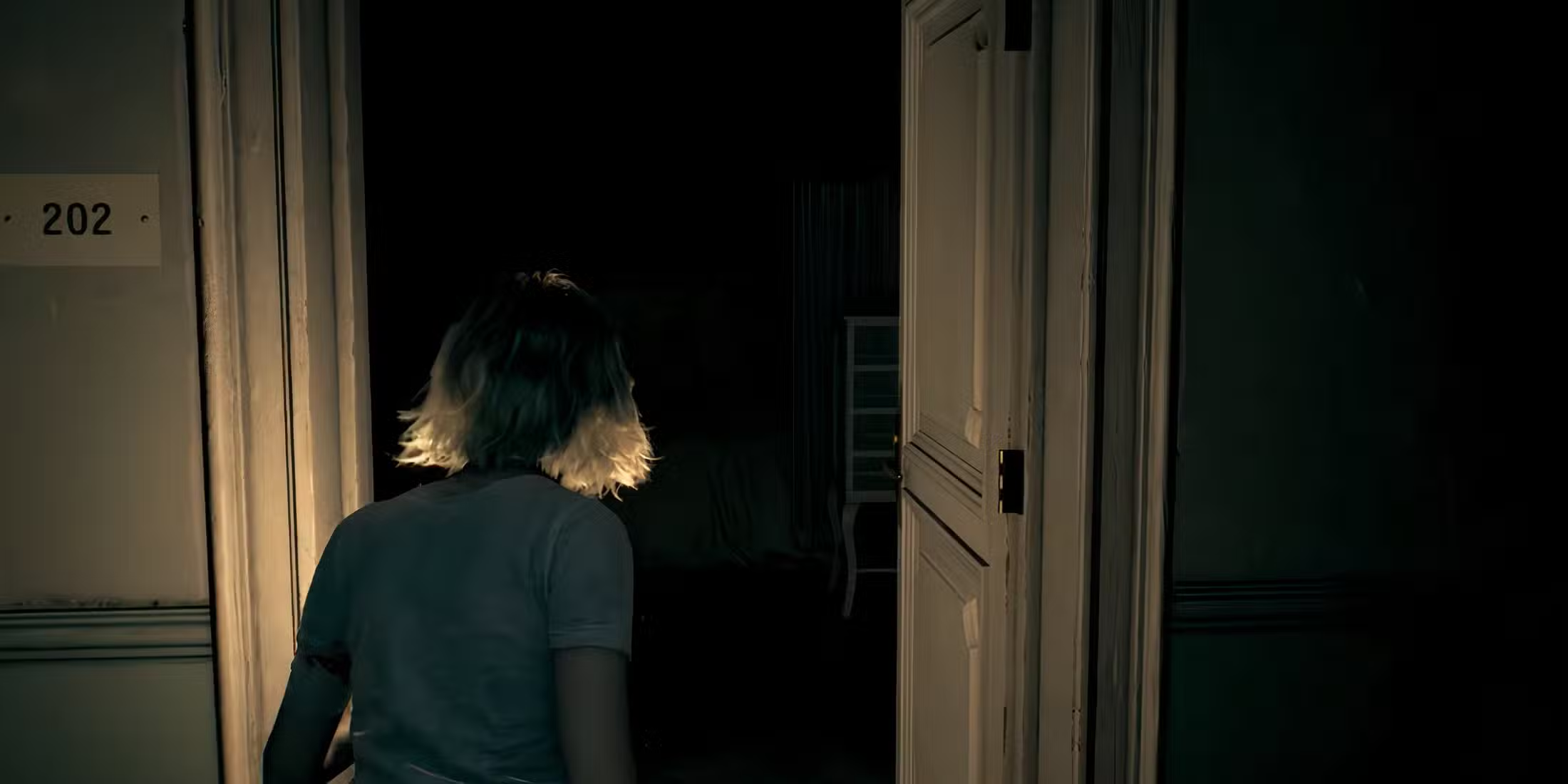
And for a deeper look at how one game uses horror atmospheres, check out our Song of Horror Review to see cosmic horror in action.
Leave a Reply